
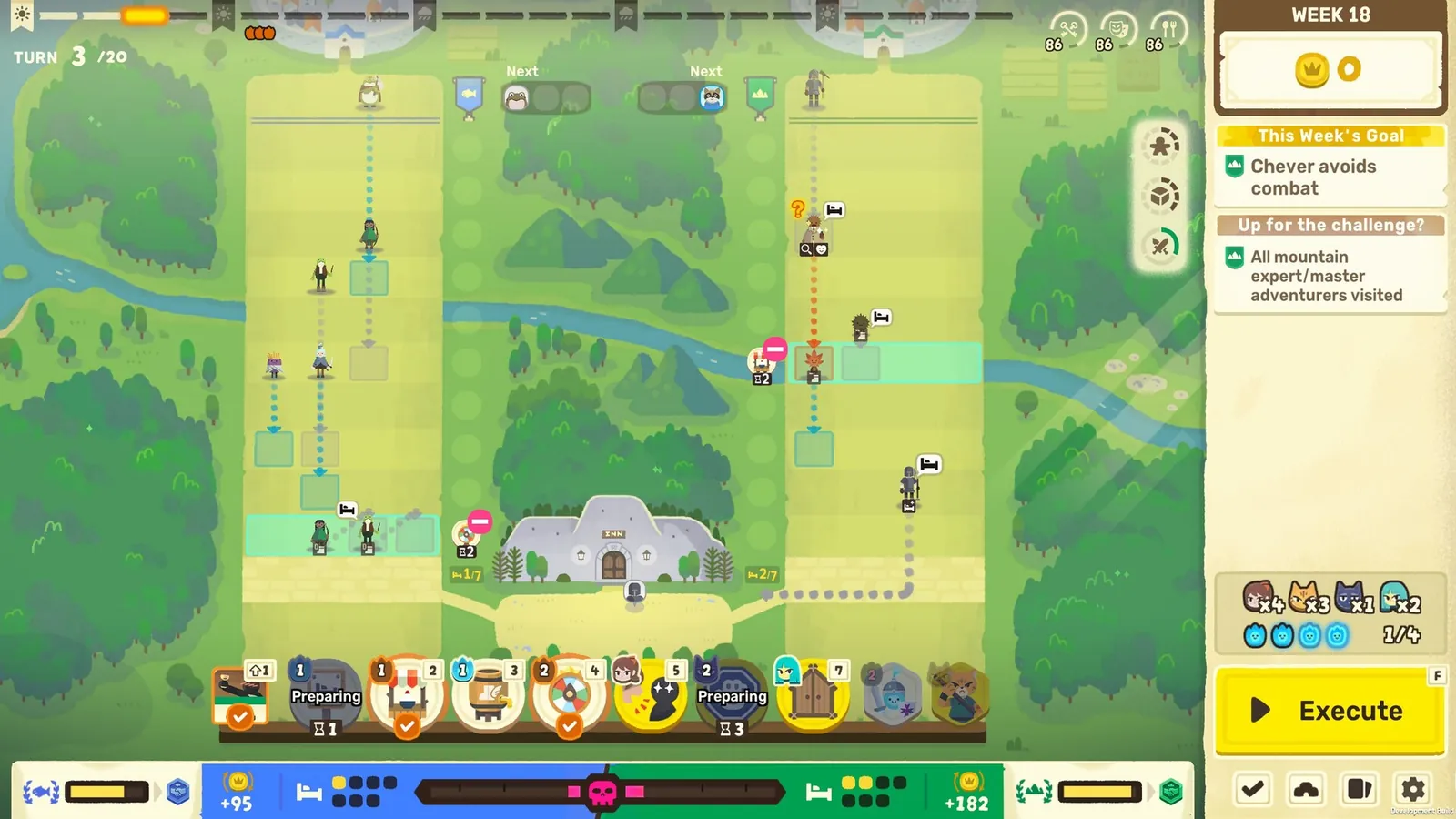
Dungeon Inn looks like a cosy inn sim until the first week teaches you what it actually is: a scheduling problem with two queues that must never queue at the same door. Everything else — the gold, the events, the upgrades — rides on whether those two arrivals stay apart.
What a day and a week actually ask of you
A day is four turns. You place devices on the roads and in the inn, then press execute and watch the turns resolve. Until you execute, decisions are reversible, so there is no reason to rush a placement: you can rearrange the whole board and still put it back.
Devices are paid for with wisps, and the schedule strip along the top of the screen shows when each wisp is out and when it returns. The inn itself is two lodges, one per guild. Beds are counted per lodge, and an adventurer who wants to stay carries a bed icon overhead. Guests leave after their stay, which frees the bed for the next arrival — a slow turnover, not a permanent block.
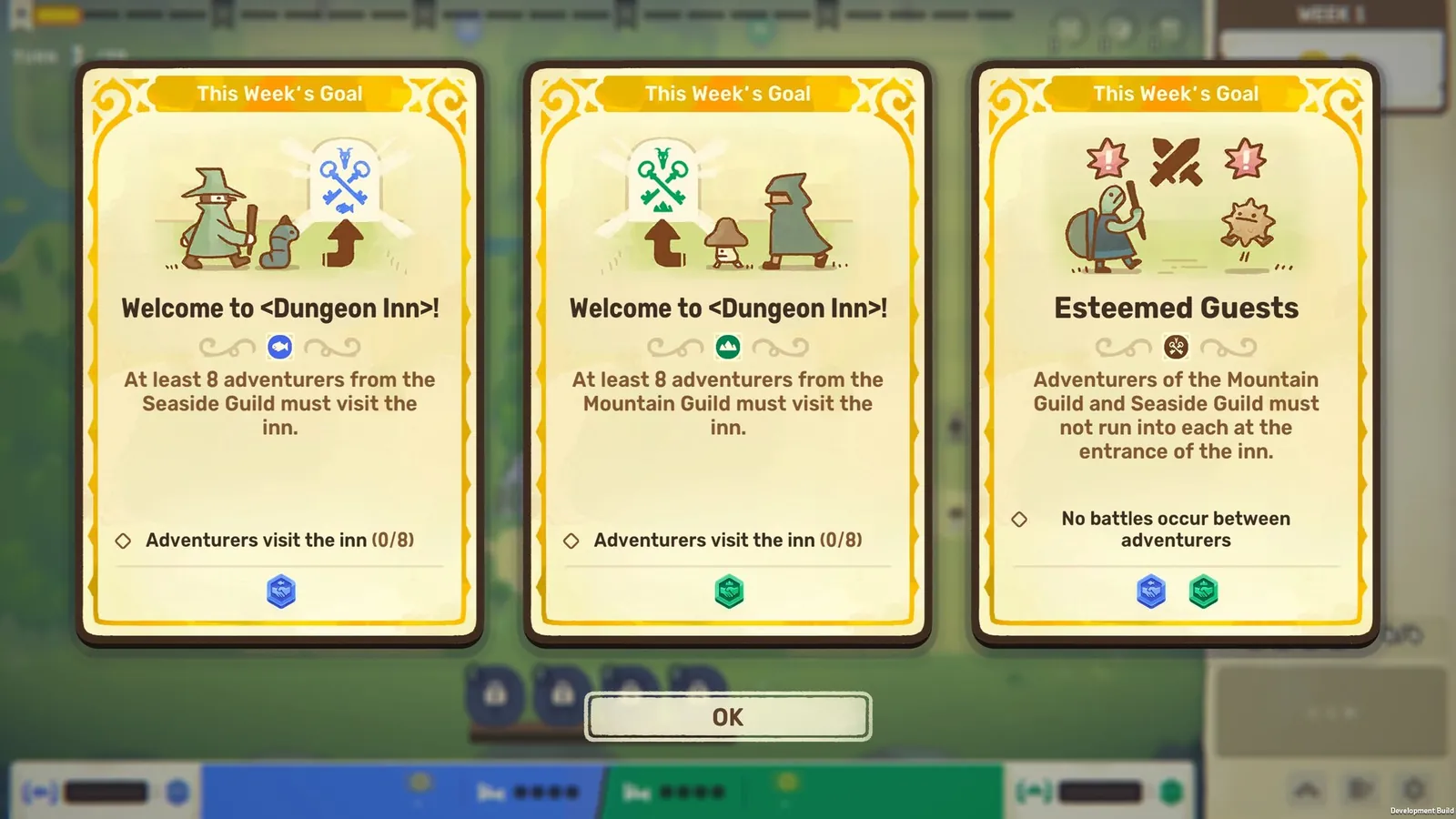
Each stage also carries mandatory goals. If they are not met, the inn does not move on, so the goals are the real to-do list for the week, not an optional scoreboard.
The three things that actually stop a first week
The door collision. Adventurers from the Mountain Guild and the Seaside Guild travel separate roads that meet at your entrance. If they arrive in the same turn, a fight starts in front of the inn. That single event is the most common way a tidy-looking week turns expensive.
The bed wall. A lodge only takes as many guests as it has beds. When the beds are full, that side turns guests away for the day regardless of how popular the inn is.
The suspicion bar. Each guild keeps its own suspicion meter. If either one fills, the double-dealing is exposed and the run cannot continue. There is no shared meter to balance and no way to trade one side’s suspicion against the other’s.
Opening moves that hold up in a real week
- Read the goals before you place a single device. The goals tell you which side needs traffic this week and whether a specific adventurer has to reach the dungeon. Placing a signboard first and reading the objectives second is how first weeks end up one bed short.
- Put the signboard close to the inn. A signboard placed further up a road pulls guests in earlier, which can also pull the two guilds together several turns later. Near the door, it converts passing traffic without rewriting the timetable.
- Compare the nearest adventurer on each road, not the whole crowd. The gap that matters is the distance remaining for the closest traveller on each side. If those two will land on the entrance in the same turn, one of them has to be moved.
- Buy beds before cosmetics. The first useful purchase is the bed count in the lodge that is turning guests away. Facility income is real, but it is settled when guests check out, so it cannot rescue a week that has no beds to sell.
- Leave one tool in reserve. Devices have costs and cooldowns. Spending the prize wheel on a traveller who was never going to collide leaves you without it on the turn that matters.
The five road tools and when each one earns its cost
| Tool | What it does | Best moment |
|---|---|---|
| Signboard | Pulls passing adventurers toward the inn | Early, when a road is quiet and the lodge has beds |
| Food stall | Pays out immediately and slows the adventurer who passes it | When you need gold now and also need one arrival pushed back |
| Energy drink | Speeds a traveller up | To push one guest through the door before a rival arrives |
| Prize wheel | Holds a traveller in place | The last resort for a collision you can already see coming |
| Armored wisps | Sent into a front-door fight to help one side | Only when a fight is already unavoidable, and you can pick the winner |
The pattern behind that table is simple. Delaying and accelerating do the same job from opposite ends, and the game gives you both so that a collision can be solved without cancelling a booking.
When the fight happens anyway
Some weeks cannot be untangled, and the fight prompt appears at the door. You can back one side with covert armored wisps, switch which side you are backing, or stay out of it entirely.
Backing the weaker side tends to pay better, and helping a side win lowers that side’s suspicion — which makes the prompt a suspicion tool as much as a combat one. Winning stories also spread among the winners, and if the same story circulates often enough it turns into a problem of its own. If you do not intervene, the winner starts wondering why nobody helped.
Where week-one suspicion comes from
Suspicion is not only a fight penalty. Events raise it, black-market offers raise it, and in 1.0 the developers deliberately increased how often and how hard it climbs during stages. Their own August devlog says the pressure is higher than in Early Access, and that Image Control was moved into the lobby — from Chapter 2, bought with guild tokens — specifically because of it.
So the first week has a second job: notice which choices cost suspicion before you take them. A black-market payout is gold with a bar attached; a volunteer shift spends gold to buy trust back.
A first-week checklist
- Goals read, and the guild that needs traffic identified.
- Bed count checked in that lodge, not the other one.
- Nearest arrival on each road compared before the first execute.
- One delay or speed tool held in reserve for the door.
- Suspicion bars checked at the end of the week, with any rise traced to the event that caused it.
What this page does not claim
The exact token price of every room and facility is not published, so this guide does not print a price list; the room and facility page explains what each tier is for instead. The same goes for a turn-by-turn opening: the recorded 1.0 playthrough shows the systems working, not a single correct sequence of placements, and the site has not played the game itself.
If the game stalls on the initial loading screen rather than starting a week, that is not a beginner problem — see the crash and loading page for the version that fixed it.